
AppMed™ provides supplementary, reliable resources focused on specific conditions and diseases to help you better understand your health. These resources are intended to offer additional information and support, but they are not a substitute for professional medical advice. It is important that any decisions or actions you consider based on this information be discussed with a qualified healthcare professional to ensure they are safe and appropriate for you individual situation. Your health and well-being are best managed with personalized guidance from your healthcare provider.

Table of content
Videos
Frequently Asked Questions (FAQ)
Watch & Learn
01 - Child care and Questionnaire
02 - Getting to the Children's Hospital (Montreal)
03 - Getting to Clinique d'Anesthésie AGM
Frequently Asked Questions
Pain
How can I tell if my child is in pain?
- Your child will most likely tell you that they are in pain or may cry. Other signs may indicate that your child is in pain: difficulty swallowing, drooling, spitting, not speaking, and refusing their favorite drink or food.
- Using a pain scale will help you determine whether your child is in pain (see below).
How do I use the pain scale?
- PPPM (Parents’ Postoperative Pain Measure)
- Children sometimes show changes in behavior while recovering from surgery. Below is a list of 15 behaviors that your child may or may not exhibit during recovery. For each behavior listed below, circle the appropriate answer: yes or no.
- Complete this assessment twice a day:
- in the morning, usually between 6 a.m. and 12 p.m., and
- in the afternoon, usually between 2 p.m. and 8 p.m.
- You may also refer to this video: PPPM Scale
- FLACC Behavioral Pain Scale
- Observe the child for 2 to 5 minutes. Observe the legs and body uncovered. Reposition the child or observe the activity. Assess the tension and tone of the body. Set up consolation interventions if necessary.
- For each category, choose the appropriate score (0, 1, or 2).
- You may also refer to this video: FLACC Scale
- FPS-R (Faces Pain Scale – R)
- Read to the child: “These faces show how much something can hurt. This face [point to the far left] shows no pain. The faces show more and more pain [point each one from left to right] until this one [point to the face to the far right] – it shows the worst pain. Point to the face that shows how much pain you are [right now].”
- Use words like “pain” or “pain,” depending on what seems to work for your child.
- You can also refer to this video: FPS-R Scale
Pain Medication
How should I administer the analgesic?
- The best way to control pain is not to wait for your child to show signs of pain. You can use acetaminophen (Tylenol) and ibuprofen (Motrin or Advil). These medications are usually sufficient to control pain. We recommend that you alternate medications (by changing places).
- For example, if you start with a dose of acetaminophen, then use ibuprofen, then acetaminophen, then ibuprofen, and so on (see chart below). Give them regularly for the first two days after surgery. After that, only give medication when your child needs it. Follow the instructions for your child’s age and weight. Use the correct dose for each medication. Do not take more tablets than what is allowed per day. Ask your pharmacist or doctor if you are unsure how much medication to give. Opioids such as morphine are rarely prescribed and are often not needed in most cases (note: there are exceptions).
- Below is an example of alternating medications for the first two days for an average 3-year-old. Your child may need different amounts of medication and different times. Ask your doctor or pharmacist to make a schedule so you know when to give your child the medications.
- 1st dose, 12:00 p.m., Acetaminophen
- 2nd dose, 3:00 pm (3 hours after), Ibuprofen
- 3rd dose, 6:00 pm (3 hours after), Acetaminophen
- 4th dose, 9:00 p.m. (3 hours later), Ibuprofen
- etc. (You may need more doses as prescribed)
- 1st dose, 6:00 pm, Ibuprofen
- 2nd dose, 9:00 am (3 hours after), Acetaminophen
- 3rd dose, 12:00 pm (3 hours after, Ibuprofen
- Continue alternating every 3 hours
What if my child doesn't like the taste of the medicine and refuses it?
- Ask your pharmacist for another formulation or brand.
- Consider using suppositories for acetaminophen and/or ibuprofen.
Where can I find ibuprofen suppositories?
- The suppository formulation of ibuprofen is not commonly found in most pharmacies.
- Here are the pharmacies that offer ibuprofen suppository
It is preferable to have a medical prescription and allow a delay of 24-48 hours because suppositories are made at the pharmacy.
514-370-8885 (closed on Saturdays)
Shortage of liquid analgesic drugs for children
- The Canadian Pharmacists Association has created an educational document for parents:
How much medicine should I give my child?
- The dose may be given as prescribed when you leave the hospital.
- You can also follow the recommended dose of acetaminophen or ibuprofen listed on the bottle.
- The dose of oral acetaminophen ranges from 12.5 mg/kg to 15 mg/kg.
- The oral dose of ibuprofen is 10 mg/kg.
- The dose of oral morphine will be calculated for you based on your doctor’s prescription. The dose of oral morphine is usually between 0.05 and 0.1 mg/kg after this procedure.
What if acetaminophen and ibuprofen are not enough to relieve your child's pain?
- Your doctor may have prescribed morphine. You can give it if your child is still in pain despite using acetaminophen and ibuprofen.
How to wean off medication?
- When the child starts to feel comfortable, you can start to decrease the medication. Every child is different.
- We recommend that you first stop morphine (if you were administering it).
- Then, decrease the frequency of acetaminophen and ibuprofen administration. For example, if you were giving 4 doses of each a day, decrease to 3 doses the next day, to 2 doses the next day, and then only if your child needs them for pain.
Apart from medication, is there anything else I can do to relieve my child's pain?
- There are non-drug pain relief strategies to help your child feel more comfortable and relaxed. Comfort your child in the way that worked best before surgery.
- Distraction will help your child take their attention away from the pain. Examples include playing games or with a favorite toy, reading or telling stories, watching TV or videos.
- For teenagers, relaxation is very useful.
- Using hot or cold ice packs on the child’s neck and/or ear can help.
Pain at Night and Sleep
What to do about night pain?
- Ibuprofen should be given before night because it lasts longer than acetaminophen.
- Be sure to give one of the pain medications before your child goes to bed. Wake the child up to give acetaminophen or ibuprofen for the first 3 days after surgery.
- If you are using morphine, do not stop acetaminophen and ibuprofen.
What about sleep?
- It may take 2 to 3 weeks before returning to a normal state.
- If you are using a humidifier, use a cool mist.
- Night terrors have been reported. Your child may have night terrors that can last for three to four weeks after surgery.
Bleeding
Is a bleeding of a few drops from the nose normal?
- Yes. This probably originated in the nasopharynx where the adenoids were removed.
- Observe and if it happens again, take your child to The Montreal Children’s Hospital immediately for an ENT examination.
If my child vomits blood, what should I do?
- Bright red blood in your child’s throat and/or vomiting from coffee beans are signs of bleeding. There is a possibility of bleeding after the operation, and it is more common between the fourth and eighth day after the operation.
- Blood may come from the nose or mouth, or be visible in sputum or vomiting. Proper hydration reduces the risk of bleeding.
- If bleeding occurs, bring your child to The Montreal Children’s Hospital immediately.
Fever
What temperature should I expect from my child after the operation?
- A mild fever of up to 38.5°C or 101°F is normal after surgery.
- Acetaminophen given for pain, cloth baths, and increased fluid intake can help lower your child’s temperature. If the fever persists for more than two days, call the ENT doctor on call. Fever can be a sign of an infection. If you have been prescribed an antibiotic, continue to take it.
- Note: you can call the ENT doctor on call between 7 a.m. and 11 p.m. for any questions. In the event of a serious problem between 11 p.m. and 7 a.m. (e.g., bleeding), go directly to the emergency room.
Hydration and Feeding
Why is hydration really important after surgery?
- An adequate intake of fluids is necessary for:
- Ensure proper hydration
- Decrease pain
- Prevent stiffness of the throat muscles
- Prevent crusting
- Facilitate swallowing
How much should my child drink after surgery?
- The amount a child should drink per day is usually based on their weight after tonsillectomy and/or adenoidectomy
| Weight (Kg) | Weight (Lbs) | Quantity (every 15 min.) | Quantity (Every hours when awake) | Daily fluid intake |
|---|---|---|---|---|
| 5–7.9 | 11–17.9 | 15 mL | 50 mL | 600 mL |
| 8–12.9 | 18–28.9 | 20 mL | 80 mL | 960 mL |
| 13–17.9 | 29–39.9 | 25 mL | 100 mL | 1200 mL |
| 18–27.9 | 40–61.9 | 30 mL | 120 mL | 1440 mL |
| 28–37.9 | 62–83.9 | 35 mL | 140 mL | 1680 mL |
| 38–47.9 | 84–105.9 | 40 mL | 160 mL | 1920 mL |
| 48–57.9 | 106–126.9 | 45 mL | 180 mL | 2160 mL |
| 58 + | 127 + | 50 mL | 200 mL | 2400 mL |
My child is losing weight. Is this normal?
- An adequate intake of fluids is necessary for:
- This is common because he eats and drinks less than normal.
- Your child may lose a few pounds after the operation. Your child may also have stomach aches if they don’t eat or drink enough.
What kind of food should I give?
- After surgery, start giving your child clear liquids. These can include water, apple juice, flat ginger ale or 7Up, popsicles, ice cream, and jelly. Your child may prefer cool liquids. If your child vomits, wait half an hour before starting to give them fluids again.
- After tonsillectomy: The day after the operation, a soft diet can be started and given as tolerated.
- A soft diet consists of: Soggy cereals, oatmeal, porridge, pancakes, a sandwich, fish, eggs, cheese, pasta, rice, a milkshake, well-cooked vegetables, soft fruit, ice cream, pudding, soup, etc.
- If necessary, blending solid foods will help your child swallow.
- Soft, cold foods can be soothing.
What foods should be avoided in the first 10 days after surgery?
- There are no strict restrictions on food avoidance.
- However, some dry and/or acidic foods could irritate the throat, including toast, crackers, tomatoes, orange juice, and lemonade.
- It is also recommended to avoid any red food, as it can look like blood when the child vomits.
Constipation
- Constipation can be seen after any surgery, due to opioids given during anesthesia or a side effect of morphine medications. It is common for the child not to have a bowel movement after the operation. Try to give them soft foods that contain fibre, such as fruit (prune juice) and vegetables, which can often help.
Other Symptoms
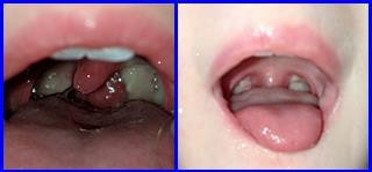
What is this white film on my child's throat?
- This is normal. It appears almost immediately after surgery and can take up to 3 weeks to go away.
- After a tonsillectomy, the back of the throat and tongue may be covered with a white membrane. This usually disappears within two weeks. Your child may also have a larger-than-normal discharge from their mouth and nose for a while.
- Example:
Are earaches (ear pain) common after this type of procedure?
- Earaches are common after tonsillectomy and/or adenoidectomy. They can be due to throat pain. Earaches can go from mild to very painful. They most often begin between the third and ninth day after the operation. Ear infections can last from three to eight days.
Will your child's voice change after surgery?
- Your child’s voice may change after tonsillectomy and/or adenoidectomy. This change of voice will be temporary and may last from one to three months.
- Do not hesitate to report this during your follow-up visit to your ENT doctor.
Is it normal for my child to cough?
- Mucus from the operation can cause a cough. If your child has a fever or is otherwise unwell, seek medical advice
Should I give my child cough syrup?
- Cough syrup is generally not recommended after surgery.
How do I know if my child has developed a throat infection?
- Your child may have a high fever (> 39.0°C), increased pain, swelling, warmth or redness, and restricted neck movement.
- These symptoms usually appear 6 to 9 days after the operation. If the pain has worsened significantly after this time, it may be a sign of infection.
Is it normal for my child to have bad breath after surgery?
- Yes, this is normal, and it will go away after a few weeks.
- Your child’s breath may be unpleasant after tonsillectomy and/or adenoidectomy. This will improve as the throat heals.
Nasal congestion after surgery
- It is normal and can last up to 2 weeks, you can use a saline nasal rinse to improve comfort in the meantime.
Activities — Do's and Don'ts
My child breathes through his mouth and has a dry throat that hurts as a result. What must I do?
- Breathing through the mouth can make the mouth and throat dry or painful. Place a humidifier near your bed when you sleep. This can make it easier for your child to breathe. To be on the safe side, it is recommended to use a cool-mist humidifier. Hot water or steam from a hot mist humidifier or steam sprayer can burn a child if they get too close. Don’t forget to follow the instructions for cleaning the machine.
What should your child avoid doing after the operation?
- Your child should try not to cough, clear their throat, or blow their nose for 10 days.
Can you brush your teeth?
- The teeth and tongue can be cleaned with a toothbrush or washcloth. Use water with a very small amount of toothpaste. Gargles and mouthwashes should not be used.
Return to Activities
- Normally, surgeons recommend that the child be able to resume activities 10 to 14 days after the procedure. The reason for this is that the risk of bleeding is during this period.
- In the meantime, your child should only do quiet activities. He must not run, cycle, jump or swim. Ask your surgeon when your child will be able to return to sports, sports competitions, or any other activity that may affect the throat.
- Avoid long-distance travel for 2 weeks due to the risk of bleeding.
When will my child be able to return to school?
- After the operation, your child should stay home for at least seven days after the adenoidectomy and ten days after the tonsillectomy (or for as long as your surgeon tells you). This will help your child recover and stop infections and bleeding. Your child should not be in contact with people who have a fever or cold. If your child is of school age, homework should be arranged with the teacher before the operation.
When should you contact your surgeon
- Persistent vomiting more than three times a day
- Pain that doesn’t go away even after giving your child the prescribed medications.
- A fever of 38.5°C or 101°F, 48 hours after surgery.
- A sore throat or earache that lasts more than 10 days after surgery.
Note: you can call the ENT doctor on call between 7 a.m. and 11 p.m. for any questions. In the event of a serious problem between 11 p.m. and 7 a.m. (e.g., bleeding), go directly to the emergency room.
When should you bring your child back to the hospital?
- Bleeding – bright red blood from the nose or mouth
- Vomiting resembling ground coffee material
Tonsillectomy and/or Adenoidectomy Pamphlet

Tonsillectomy and/or Adenoidectomy Pamphlet
PDF · Revised 2022 · v1.61
AppMed™ Resourses LUPIN – Reviewed: 2026-05-04
© AppMed Inc. All Rights Reserved.